
Trends in Employee Engagement in 2026
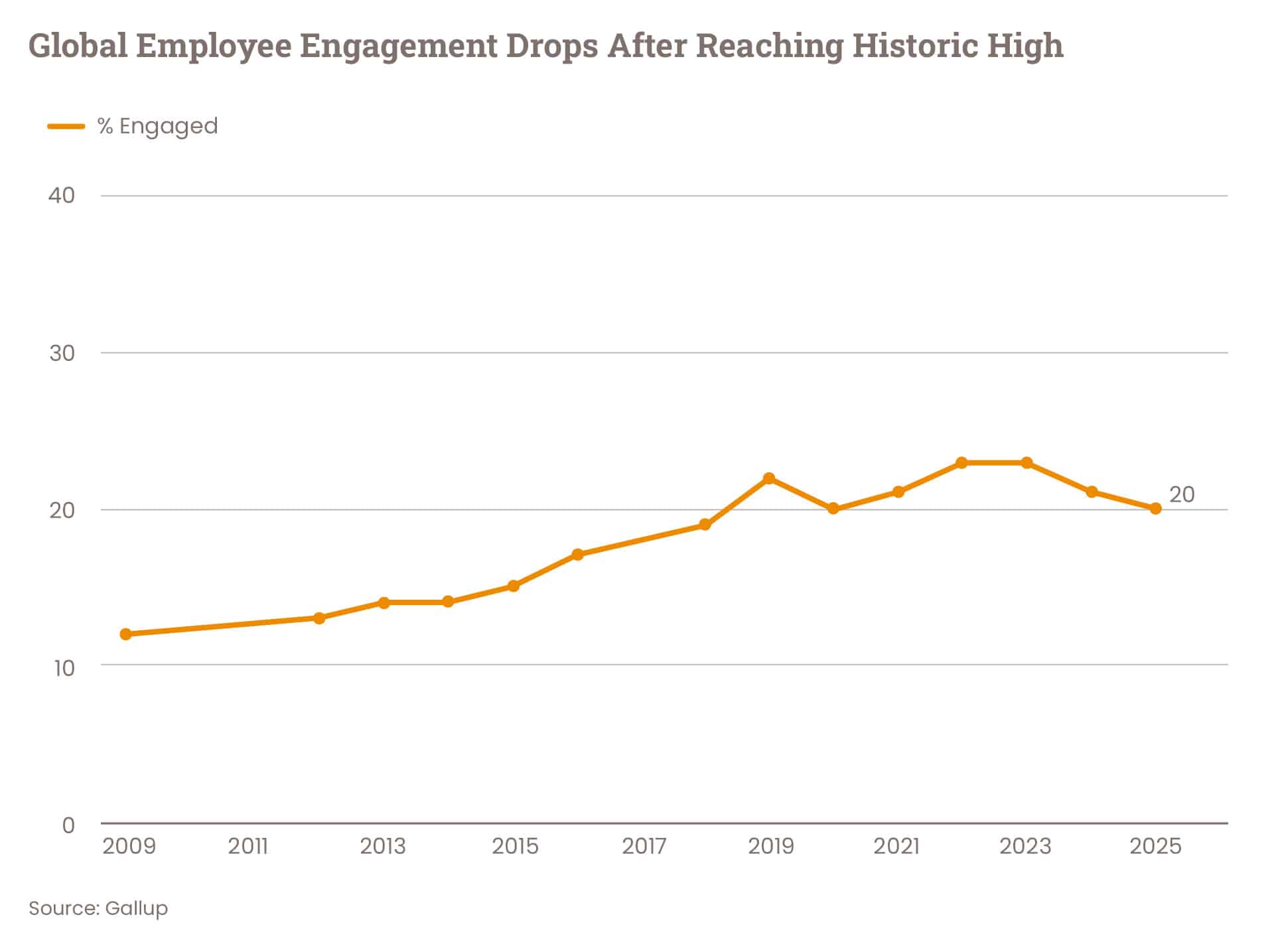
Employee engagement is declining during a period when organizational productivity is critically needed. According to the State of the Global Workplace 2026 report by Gallup, global employee engagement decreased to 20% in 2025, compared to 23% in 2022.
This marks the first consecutive two-year decline in engagement, indicating a shift in how employees relate to their work, teams, and employers. Notably, no region of the world recorded an increase in employee engagement during this period.
Although engagement levels remain higher than in previous decades, the recent decline raises significant concerns for organizations that rely on workforce productivity to achieve outcomes.
Why Is Employee Engagement Declining?
Several structural and behavioral changes within the workplace are contributing to the decline in employee engagement.
Declining Manager Engagement
Manager engagement has declined significantly, decreasing by nine percentage points since 2022. This trend is critical, as managers have a direct influence on team engagement. Disengaged managers often lead to reduced employee engagement.
Expansion of Team Sizes and Reduction in Management Roles
Many organizations are adopting flatter structures and reducing the number of management roles. As team sizes increase, managers face challenges in providing adequate support to employees, which contributes to decreased employee engagement.
AI Disruption and Uncertainty
Artificial intelligence is transforming workplace dynamics, but also generating uncertainty. Although employees acknowledge productivity benefits, rising concerns about job security and changing roles are contributing to reduced engagement.
Changes in Job Market Confidence
Employee perceptions of job opportunities have diminished in key regions. Reduced perceived options are associated with lower levels of engagement.
How Does Low Employee Engagement Impact Workforce Productivity?
Low employee engagement directly and measurably reduces workforce productivity.
According to Gallup, last year, disengaged employees cost an estimated $10 trillion in lost productivity globally, representing approximately 9% of global GDP.
Key Business Impacts
- Lower efficiency and output across teams.
- Reduced profitability and sales performance.
- Increased absenteeism and turnover.
- Higher operational costs.
Employee engagement reflects the degree of psychological commitment employees maintain toward their work. A weakened connection typically results in decreased productivity.
In organizations with shift-based or distributed teams, low employee engagement can rapidly disrupt operations, leading to missed shifts, increased overtime, and diminished workforce flexibility.
What Role Does AI Play in Employee Engagement?
AI is improving individual productivity, but its impact at the organizational level remains limited.
What the Data Shows
- 65% of U.S. employees report that AI has a positive impact on their productivity.
- Only 12% strongly agree that AI has transformed how work gets done.
- 89% of leaders report no measurable productivity gains from AI in the past three years.
- Leaders expect only a 1.4% productivity increase over the next 3 years with AI.
These findings underscore a disconnect between individual efficiency gains and broader improvements in workforce productivity.
Manager Support Drives AI Success
Employees are significantly more likely to perceive value in AI when managers actively support its implementation. However, fewer than one-third of employees report receiving strong managerial support for AI adoption.
Organizations that do not address this gap risk experiencing lower employee engagement and underwhelming returns on technology investments.
The Necessity of Employee Engagement for Effective Workforce Operations
Employee engagement extends beyond a cultural metric; it serves as a key driver of operational performance.
Impact on Frontline Workforces
Low employee engagement can lead to:
- Unfilled or poorly managed shifts.
- Increased reliance on overtime.
- Reduced schedule flexibility.
- Lower employee retention.
In industries such as logistics, manufacturing, and healthcare, these challenges directly affect service levels and profitability.
Employee Engagement as an Indicator of Readiness for Change
Employee engagement also indicates a workforce’s preparedness to adapt to change. Organizations with engaged employees are better positioned to adopt new technologies, including AI, and maintain productivity during transitions.
How Can Organizations Improve Employee Engagement?
Enhancing employee engagement requires deliberate strategies that integrate leadership development, effective communication, and technological solutions.
1. Invest in Managerial Development
Managers have the greatest influence on employee engagement. Organizations should prioritize leadership training, coaching, support tools, and maintaining manageable team sizes.
2. Increase Flexibility for Employees
Flexibility is a primary driver of employee engagement, particularly for hourly and frontline workers. Providing employees with greater control over their schedules improves participation and satisfaction.
3. Strengthen Organizational Communication
Transparent communication regarding workplace changes, including AI adoption, helps reduce uncertainty and builds trust.
4. Leverage Technology to Empower Employees
Workforce management tools, such as shift scheduling platforms, can enhance employee engagement by giving them greater control over their time and work responsibilities.
How Shift-Based Organizations Can Improve Employee Engagement
Organizations with multi-site or hourly workforces encounter distinct challenges in maintaining employee engagement.
Effective Strategies for Shift-Based Workforces Include:
- Enabling easy shift swaps and schedule visibility.
- Reducing administrative burden on managers.
- Allowing employees to pick up or trade shifts.
- Creating transparent and fair scheduling processes.
Solutions such as ShiftSwap™ enable organizations to streamline workforce coordination and improve employee engagement and productivity.
When employees have greater control and visibility over their work, they are more likely to remain engaged and contribute to operational success.
The Importance of Engagement in 2026
The decline in employee engagement serves as a clear indicator that organizations must take action. As workplaces evolve and AI adoption accelerates, maintaining strong employee engagement is essential for sustaining workforce productivity.
Organizations that prioritize engagement, support managerial development, and empower employees with appropriate tools will be better positioned to navigate change and achieve long-term success.
Key Takeaways
- Employee engagement declined to 20% in 2025, marking a two-year drop that raises concerns for productivity.
- Declining manager engagement and uncertainty from AI contribute to this decrease in employee engagement.
- Low engagement leads to significant productivity loss, costing an estimated $10 trillion globally, or 9% of GDP.
- Organizations must prioritize managerial development, flexible policies, and transparent communication to enhance engagement.
- Shift-based organizations can improve engagement by allowing shift swaps and reducing managerial burdens.
Article FAQs
Employee engagement measures how connected employees feel to their work, team, and organization.
Employee engagement is declining due to reduced manager engagement, organizational changes, AI-related uncertainty, and shifting perceptions of the job market.
Higher employee engagement leads to better performance and efficiency, while low engagement reduces workforce productivity and increases costs.
Managers are the primary drivers of employee engagement. Their level of engagement directly impacts the teams they lead.
Companies can improve employee engagement by investing in managers, increasing flexibility, improving communication, and using workforce management tools.