
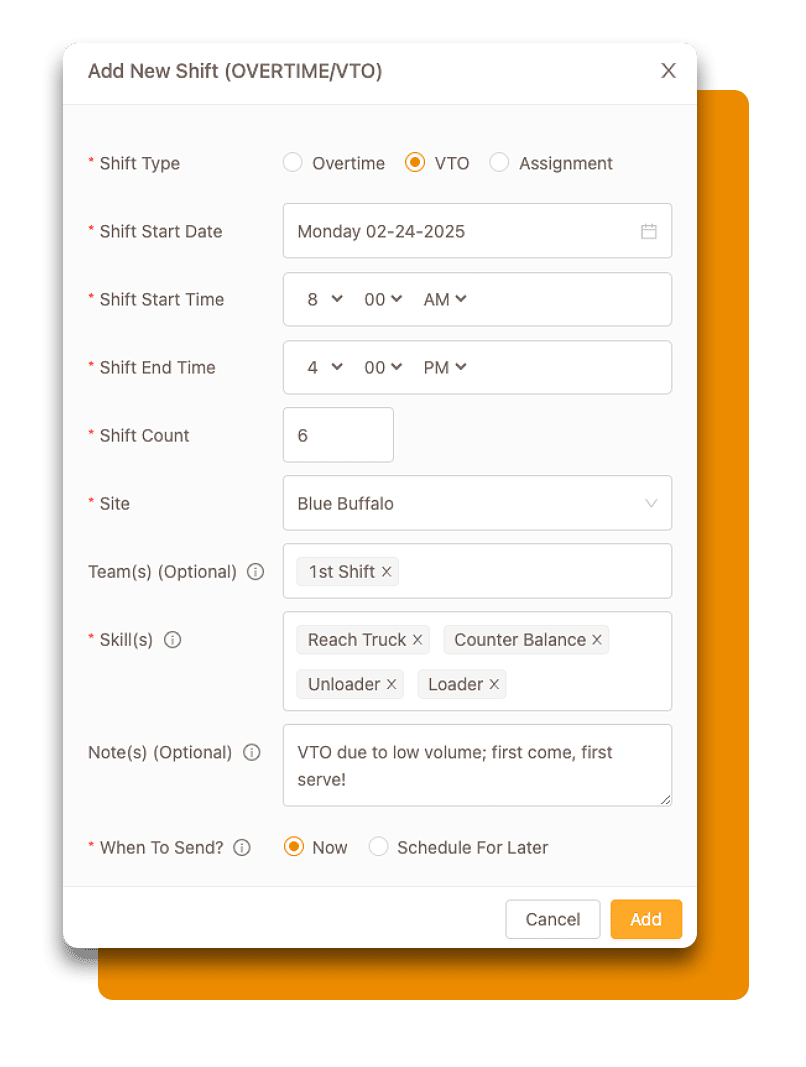
Automate shift coverage, reduce labor costs, and optimize voluntary time off (VTO) shifts with ShiftSwap™
Labor costs can account for up to 80% of operational expenses. ShiftSwap™ helps you minimize inefficiencies and streamline costs, all while maintaining workforce satisfaction.
Offer employees the ability to post shifts for coverage seamlessly.
Align labor supply with peak demands to maintain efficiency.
Improve employee satisfaction and productivity with flexible scheduling.
A logistics operation with 70 workers at this location faced the ongoing challenge of fluctuating volume and associated labor costs. Staffing to peak demand led to inflated expenses during slower periods, while average staffing levels often resulted in mandatory overtime to meet spikes in demand. The inconsistency impacted both operational efficiency and employee satisfaction.
By incorporating ShiftSwap™ into its operations, the company utilized Voluntary Time Off (VTO) to adjust labor to meet real-time volume needs. This streamlined scheduling and provided employees with more flexibility, all managed through an intuitive platform.
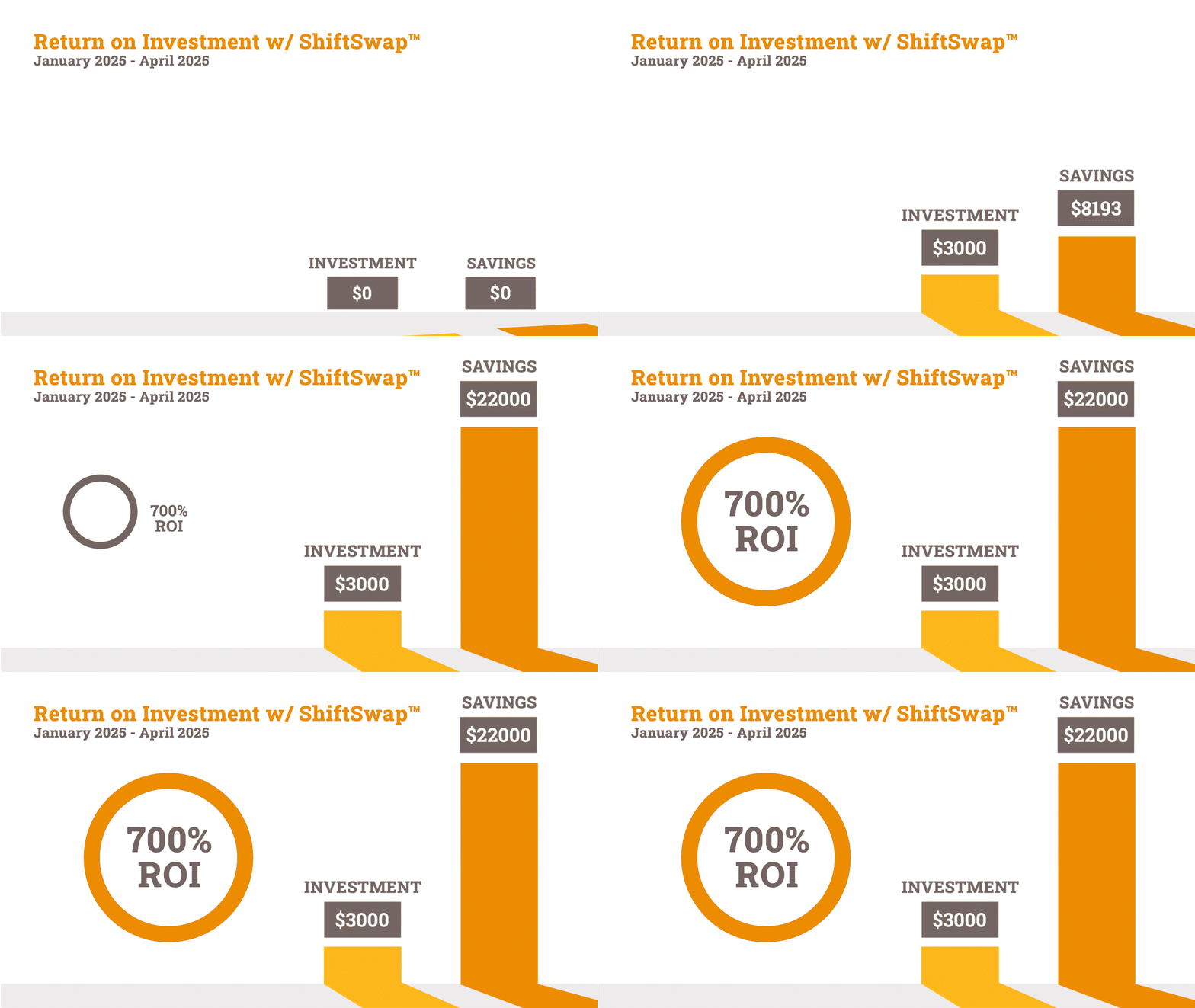
In just 4 months, the company achieved remarkable results. A $3,000 investment in ShiftSwap™ saved approximately $22,000 in labor costs, yielding a 700% return on investment (ROI). Utilizing the VTO shift posting feature, the company reduced unnecessary labor costs during slow periods while maintaining lean and effective operations.
For this major retailer with 305 workers at this site, winter’s slower volumes often led to overstaffing, which drove up costs or forced tough layoff decisions. As spring approached, they rushed to hire and train new employees to meet the increased demand. The constant cycle of hiring and layoffs was costly and detrimental to employee morale.
By incorporating ShiftSwap™ into its operations, the company utilized posting Voluntary Time Off (VTO) shifts to adjust labor to meet real-time volume needs. With streamlined scheduling, employees are provided with more flexibility, all managed through a user-friendly platform.
By leveraging VTO, the company reduced unnecessary labor expenses without compromising operational readiness, resulting in approximately $477,975 in labor cost savings. With a fully retained workforce, the company ramped up operations seamlessly for their busiest season, avoiding the costs and delays of hiring and training new staff.

See how ShiftSwap™ simplifies workforce management and reduces labor costs for your operations.
labor cost reduction
Labor costs are one of the largest expenses for most organizations, and inefficiencies, such as overstaffing or idle workers, drive costs even higher. ShiftSwap helps reduce labor costs by aligning labor supply with demand quickly and efficiently. For example, managers can offer voluntary time off (VTO) when demand is low, reducing wasted payroll hours. Over time, these adjustments prevent unnecessary overtime and help businesses control costs while maintaining a satisfied workforce.
Voluntary time off (VTO) allows workers to give up a scheduled shift without penalty when demand is lower than expected. Instead of paying employees to remain idle, businesses can instantly post open VTO slots for eligible workers to claim on a first-come, first-served basis. The non-biased, simple option helps companies avoid wasted payroll hours while giving employees flexibility. It is a win-win for both cost control and employee morale.
Idle workers can cost companies thousands of dollars every week. ShiftSwap solves this by allowing managers to quickly adjust staffing levels to reduce labor costs. If a forecast shows lower demand, managers can instantly reduce unnecessary shifts through VTO postings. Every labor cost is spent productively, improving overall efficiency and protecting profit margins.
When done strategically, you can reduce labor costs while maintaining high employee satisfaction. Many workers value having control over their schedules just as much as their hourly pay. By offering flexible VTO options, employees can choose time off at a convenient time for them, whether for rest, family needs, or personal errands. Instead of forced layoffs or mandatory hour cuts, businesses maintain engagement and decrease turnover while still reducing costs.
While every industry faces labor cost challenges, ShiftSwap is especially valuable in sectors with fluctuating demand and hourly employees, including warehousing, manufacturing, retail, and hospitality. In these industries, overstaffing often leads to wasted payroll, while understaffing risks burnout and missed deadlines. ShiftSwap balances both, making operations more predictable and cost-efficient.
Savings vary by industry and workforce size, but even small adjustments can add up quickly. For example, paying 10 idle workers $26/hour for an 8-hour shift costs more than $2,000 in wasted labor. By preventing just a handful of these situations each month, companies can save tens of thousands of dollars annually while improving workforce efficiency.
Traditional scheduling often relies on static planning, which doesn’t account for daily or hourly demand changes. It creates gaps where businesses either overspend on idle workers or scramble to cover understaffed shifts with costly overtime. ShiftSwap uses real-time adjustments and voluntary time off to ensure labor costs stay aligned with operational needs, a feature that outdated methods can’t easily achieve.
Managing labor costs doesn’t mean cutting jobs; it often involves optimizing them. With ShiftSwap, companies can align daily labor supply with demand by offering voluntary time off (VTO) and shift coverage opportunities. This approach enables businesses to manage labor costs effectively while maintaining their workforce, thereby avoiding costly layoffs and future rehiring expenses.
Cost productivity measures how efficiently labor contributes to output in relation to its costs. When operations have idle workers or unnecessary overtime, productivity suffers. ShiftSwap improves cost productivity by ensuring the correct number of workers are scheduled at the right times, minimizing wasted labor hours, and maximizing output per dollar spent.
Cutting labor costs recklessly, such as through layoffs or reduced hours, often leads to burnout, low morale, and increased turnover, which ultimately raise costs in the long run. ShiftSwap helps businesses strategically cut labor costs by utilizing shift management tools that preserve workforce morale while reducing costs.
Yes. By eliminating inefficiencies in shift management and empowering employees with flexibility, ShiftSwap improves labor productivity. Employees work shifts that better fit their availability and energy levels, while businesses reduce overtime and absenteeism, achieving more output with fewer wasted hours.
Contribution margin, the difference between sales revenue and variable costs, is heavily influenced by labor costs. When labor costs rise due to absenteeism, turnover, or poor scheduling, contribution margin shrinks. ShiftSwap helps protect contribution margins by reducing excess labor costs and maintaining high productivity through flexible, optimized staffing.
Focusing only on reducing costs can backfire if it weakens performance. Improving labor productivity means maximizing what your workforce delivers without overspending. With ShiftSwap, organizations balance both: cutting unnecessary labor costs while boosting productivity through streamlined, employee-driven shift management.