
How Can 3PLs Improve Client Experience in the First Year?
The first year of a third-party logistics (3PL) relationship is when clients determine if the provider is truly a partner or simply a vendor.
Even after a 3PL secures the account, completes implementation, and begins order fulfillment, clients continue to assess the overall experience. They focus on communication clarity, problem-solving, invoice accuracy, and adaptability to change.
These factors influence the 3PL client experience long after onboarding ends.
FulfillYN’s 2026 report, The 3PL Client Experience Benchmark: Year One Is the Worst Year, surveyed 111 brands currently working with third-party logistics providers. The report found that first-year clients gave the lowest ratings across the experience measures it studied, while satisfaction scores rose in longer-tenured client groups.
The report notes several limitations. It surveyed only current clients, excluding those who ended provider relationships. The first-year group included 12 respondents, and longer-tenured groups reflect survivorship bias. Therefore, the findings are directional, not definitive proof that all relationships improve. However, the results suggest 3PL leaders should focus on the post-launch period.
Why Does The First Year Matter To The 3PL Client Experience?
The report challenges the prevailing assumption that new clients experience the highest satisfaction immediately following contract initiation.
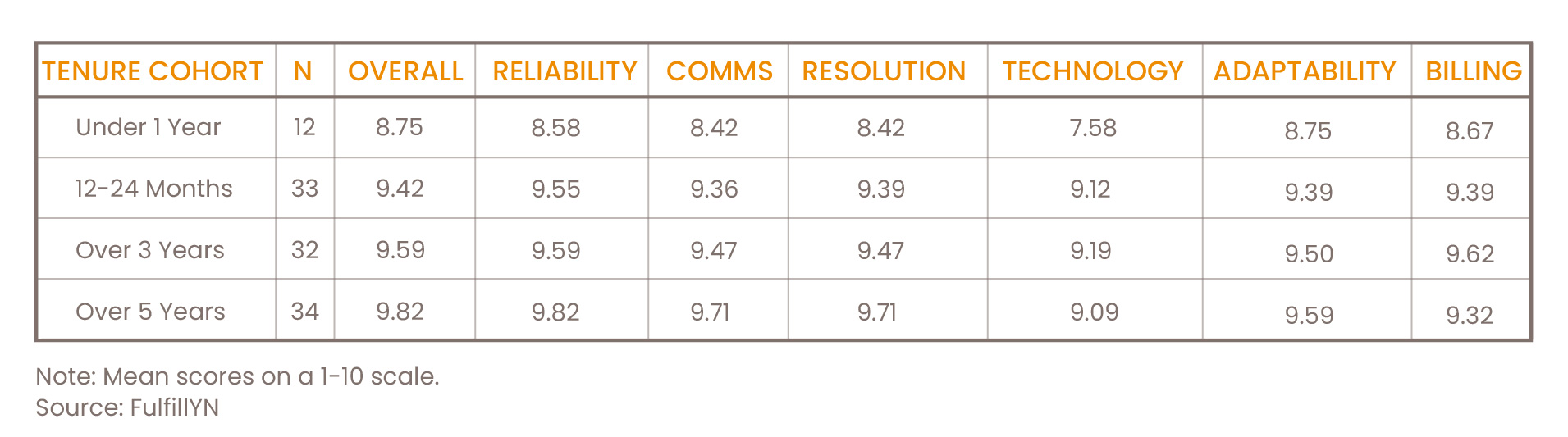
Clients with less than one year of tenure gave their provider an average overall satisfaction score of 8.75 out of 10. The 12 to 24-month cohort averaged 9.42. Clients with more than three years of tenure averaged 9.59, and those with more than five years averaged 9.82.
The first-year cohort also recorded lower scores across reliability, communication, problem resolution, technology, adaptability, and billing transparency.
For example, first-year clients rated communication effectiveness at 8.42. Clients with more than five years of tenure rated it 9.71. First-year clients rated technology and visibility 7.58, while the longest-tenured group rated it 9.09.
While the data do not show that tenure alone increases satisfaction, they suggest the initial months require greater operational and executive attention. Client perceptions are most influenced after launch and before the relationship is fully established.
To strengthen the 3PL client experience, extend onboarding support beyond the initial go-live phase.
What Are The Main First-Year Client Risks?
The report identifies technology and billing as notable early concerns.
Among first-year clients, 25% reported a technology issue that materially affected their operations. The report found that 16.7% of first-year clients reported a billing discrepancy. Among clients with more than five years of tenure, none reported a billing discrepancy.
Due to the small first-year sample size, these figures are not representative of industry-wide rates. However, they offer valuable insights for management decisions.
Early in the relationship, new clients need assurance that systems function as intended, invoices are transparent, and accountability for inquiries is clear. Technology issues, unexpected charges, or unresolved requests can quickly erode trust, especially when clients compare actual performance to sales expectations.
3PLs can improve the 3PL client experience by scheduling early account-health reviews that address:
- Technology access, integrations, and reporting needs
- Invoice accuracy and billing questions
- Escalation contacts and response expectations
- Open operational issues and recovery plans
- Feedback from the client’s daily users
The goal is to identify and resolve issues before they cause clients to reconsider the relationship.
Why Is Technology The Lowest-Rated Dimension?
Technology and visibility received the lowest mean score of the six experience dimensions in the report: 8.96 out of 10. It was also the only dimension with a mean below 9.0.
Across the 111 respondents, 29.7% rated their provider’s technology at 8 or below. By comparison, 8.1% rated reliability at 8 or below.
Technology was also the lowest-scoring category for 20 of the 60 brands whose scores varied across dimensions. The report excluded 51 respondents who gave identical scores across all categories from this specific analysis.
These results show that clients are sensitive to technological shortcomings, such as delayed visibility, unsynchronized systems, incomplete inventory data, or inefficient reporting. However, technology alone does not build a strong client relationship.
What Drives Overall 3PL Client Satisfaction?
FulfillYN modeled overall satisfaction against six component dimensions: reliability, communication, problem resolution, technology, adaptability, and billing clarity. The model explained 77% of the variation in overall satisfaction.
Communication had the largest standardized coefficient at .35. Adaptability followed at .25. Billing clarity was at .17, problem resolution at .16, and reliability at .08. Technology’s coefficient was negative .01 and indistinguishable from zero in the model.
This finding does not diminish the importance of technology. Clients still rated it as the weakest dimension and reported related operational issues. However, the analysis suggests technology did not independently drive overall satisfaction when other factors were considered.
For the 3PL client experience, communication stood out as the strongest driver.
Clients may accept less advanced technology if the provider offers clear communication, accountability, and consistent follow-through. Conversely, strong technology cannot make up for unaddressed inquiries, unclear escalation procedures, or inconsistent responses.
How Should 3PLs Communicate When Something Goes Wrong?
Service failures occur. The report found that 25 brands described genuine failures related to delays and on-time performance, including missed windows, damaged products, unsynced systems, and untracked inventory.
Yet 17 of those 25 brands, or 68%, still rated their provider a 9 or 10 overall.
Brands that experienced a service failure reported an average overall satisfaction score of 9.04, compared to 9.71 among brands without such incidents. While this difference is significant, the report demonstrates that a service failure does not necessarily terminate the client relationship.
Clients’ experiences were shaped by what happened after the problem occurred.
About one-third of the 103 substantive challenge narratives described a custom process the 3PL built to address the client’s situation. In roughly one in eleven narratives, clients said their 3PL identified the problem before they did.
These findings suggest clients value ownership and responsiveness. They want providers to communicate early, explain recovery plans, and adapt when standard processes do not resolve issues.
What Communication Practices Can Strengthen The Relationship?
The report reviewed communication setups among 43 brands that provided enough detail to identify channels. Email was the most frequently mentioned, followed by phone, shared Slack channels, and text messages.
The 10 brands that named a shared Slack channel had the highest average communication score (9.8) and the highest average overall score (9.8). None rated their provider below 9 overall.
The report clearly labels this result as directional. The subgroup is small, and brands that described their communication setup may differ from brands that did not. It does not prove that Slack causes higher satisfaction.
More broadly, clients value communication that is accessible, consistent, and involves individuals empowered to act.
To improve 3PL client communication, providers can:
- Publish response-time standards for routine and urgent requests.
- Communicate delays before the client needs to ask.
- Clarify the next action, responsible owner, and expected timing.
- Close the loop after resolving an issue.
- Review recurring requests for opportunities to improve the process.
How Can Workforce Operations Support Client Experience?
Effective client communication relies on operational follow-through. When facilities face changing volumes, call-outs, overtime needs, or coverage gaps, internal teams need clear response processes.
ShiftSwap™ helps organizations communicate available shifts to qualified employees through a structured workflow. Managers can post opportunities, employees can view and request available work, and leadership can review coverage before confirming it.
This solution does not replace the client relationship but supports the operational coordination behind it. Improved internal communication helps teams address staffing changes consistently, supporting the reliable execution clients expect.
What Should 3PL Leaders Do Next?
The report’s central recommendation is to maintain a high level of attention and engagement following client launch.
Develop a first-year account plan with technology checks, billing reviews, regular feedback, clear response standards, and visible leadership involvement. Track whether clients receive timely answers and if recurring concerns lead to process improvements.
The quality of the 3PL client experience is determined less by avoiding failures and more by the provider’s communication, adaptability, and accountability in response to challenges.
Key Takeaways
- The first year is critical for 3PL client experience, as clients assess communication, problem-solving, and adaptability during this period.
- Clients rated their satisfaction lower in the first year compared to longer-term relationships, highlighting the need for focused attention.
- Key risks during the first year include technology issues and billing discrepancies, as these can significantly affect trust.
- Effective communication drives overall satisfaction; clients prioritize clear communication and responsiveness over technology quality alone.
- 3PLs should develop a first-year account plan that includes regular feedback and proactive problem resolution to enhance the client experience.
FAQs
The 3PL client experience is how a brand evaluates its provider across factors such as reliability, communication, problem resolution, technology, adaptability, billing, and overall satisfaction.
In FulfillYN’s survey of 111 current 3PL clients, the first-year cohort gave the lowest overall satisfaction score and the lowest ratings across the measured experience dimensions.
Communication had the strongest independent relationship with overall satisfaction in the report’s model, with a standardized coefficient of .35.
No. According to FulfillYN’s report, 68% of brands that described a genuine service failure still rated their provider a 9 or 10 overall. Clear communication and recovery actions can influence how clients view the experience.
Technology and communication both matter for 3PLs. Technology received the lowest average score in FulfillYN’s report, but communication had the strongest independent relationship with overall satisfaction. Providers should improve technology while also setting clear communication ownership and response standards.